Great at what you do. Terrible at telling your story.

You've done work that matters. It just isn't showing up on your resume, on your LinkedIn, or in your answer when someone asks what you do.

See how it works ↓
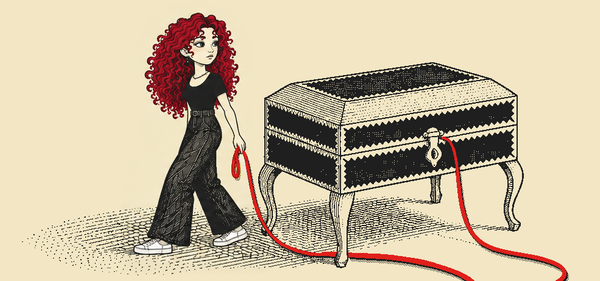
A curly-haired woman pulling a jewelry box by a red thread

This you?

  • You read a job posting, think "that's literally me," and close the tab anyway.
  • Someone asks "so what do you do?" and you shrink your job down to the boring version.
  • You have a folder of screenshots where people thank you, and none of it is on your resume.
  • Every time you sit down to update it, you end up listing tasks and hating every word.
  • Your LinkedIn hasn't changed since the job before this one, and you know it.

Your resume isn't the problem.

Everyone starts by polishing the resume, and that's exactly why it never lands.

A story needs somewhere to go.

Most resumes don't have that, so they just list what happened. Finding yours is where I start.

I read your work history next to your birth details, because they show me how you're actually wired, the parts of you that never make it into a job title. Then I come back with two or three directions you could actually go. You pick one, and every piece of your kit gets built to point there.

Here's what changes.

  1. You close the tab anyway.You read a job posting, think "that's literally me," and apply that same afternoon.
  2. You shrink your job down to the boring version.Someone asks what you do, and you've got a one-line answer you actually like saying.Sydney's: "I prove what works with customers, then move it into the product."
  3. None of it is on your resume.Those thank-you screenshots live on your own site, right next to the numbers that back them up.
  4. Listing tasks and hating every word.Your resume reads like proof instead of a task list, and you didn't have to write a word of it.
  5. Your LinkedIn hasn't changed since the job before this one.Your LinkedIn, your resume and your site all say the same thing, and it finally sounds like you.

That's the career kit. I find your direction first, then build everything else to point there, all within about a week.

Same job title. Two different directions.

Two people, two directions, two stories.

Sawwa closed more customer conversations than anyone on his team, held the best rating of anyone with 50+ reviews, and was quietly shipping bug fixes himself with Claude Code. His old resume listed tasks.

What I saw wasn't "support." He's the person who turns frustrated users into fans and problems into fixes, so that became his direction.

He walked away with a resume that leads with his numbers and a site that tells the whole story in ten seconds.
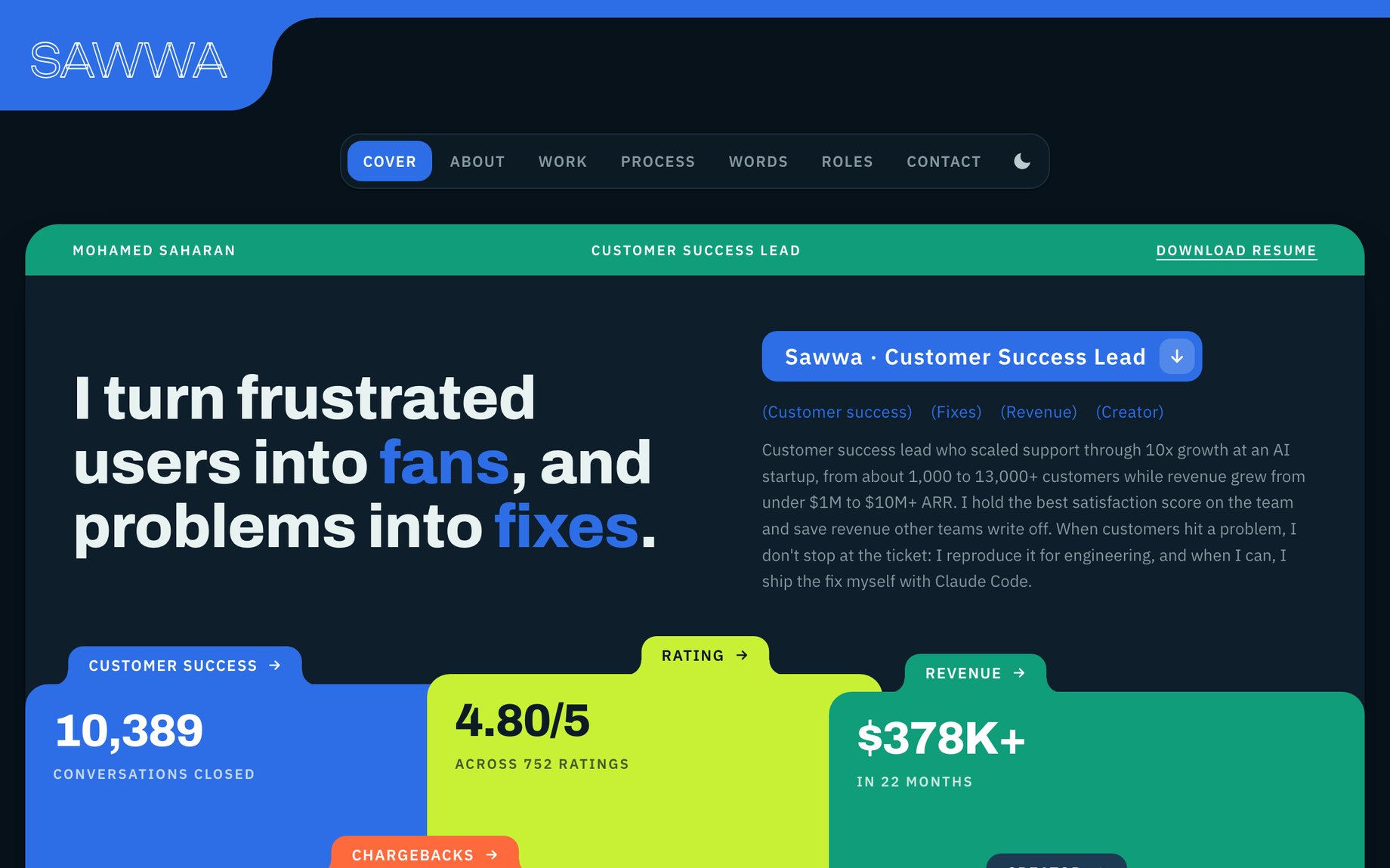
Sawwa's portfolio site, opening on his headline and his headline numbers
See Sawwa's live site → Click around, it's his.

Sawwa and Sydney both went with the folder look. It's one of a few styles, and yours gets picked to fit you and your work.

This is for you if

Checklist
  • You're great at what you do, you know it, and your resume doesn't.
  • You pay for Claude Code or Codex and actually use it, but none of that shows up on paper.
  • You're open to a direction you might not have picked on your own.
  • You're good sharing your birth details, and a little curious what they say about how you work.
  • You want something you own and can keep updating, not a one-off PDF.

Probably not for you if you need a resume by tomorrow, or you'd rather not share your birth details.

What you get

Five pieces, built for you by hand, within a week of you picking your direction.

01 Direction

A direction memo

Two or three directions you could actually go, laid out plainly. You pick one and everything else gets built around it.

02 ATS

An ATS resume

The one you send with applications, written so the filters read it right and a recruiter gets you in ten seconds.

03 Designed

A designed resume

Two pages for humans. The one you hand over in person or drop in a DM when you want to be remembered.

04 LinkedIn

LinkedIn copy

Headline, about section and experience, ready to paste in so your profile finally says the same thing you do.

05 Your site

Your own portfolio site

A real website that's yours to keep, change and point people to, with guides so you can host and update it yourself.

How it works

  1. Payand you're in.
  2. Fill the intakeIt takes about 30 minutes, and it's where I get to know how you work and what you want next.
  3. I hand-pick your directionsTwo or three places you could go, read from your birth details and your work, within 24 hours.
  4. Pick oneThat's the only big decision you have to make.
  5. Your kit landswithin a week, with a preview link to your site and the guides to make it yours.

From people who've had one

Sawwa

[SAWWA QUOTE]

Sydney

"You've set me up like this / made the first step in everything I've done."

Athena, drawn with curly red hair, holding a fountain pen

Hi, I'm Athena.

I've spent my whole career helping people say what they mean.

First as an editor, including a year at the Los Angeles Review of Books, then one-on-one with thousands of customers building with AI. The work was always the same: listen until someone says what they actually mean, then put it in a form that works for them.

I built this kit for myself first, then for Sawwa and Sydney, and it's not the first time I've done it. Helping people show who they are is my favorite kind of work, so I'm sharing it.

Questions people ask

Why do you need my birth details?

They're how I see how you're wired: how you decide, where your energy goes and what kind of work actually fits you. It's a way of reading people I've spent years building, and it sits next to your work history, which still carries most of the weight.

What if none of the directions feel right?

Tell me what's off. Picking a direction is the one big decision you make, so I'd rather get it right with you before I build anything.

How much of my time does this take?

About 30 minutes for the intake, a few minutes to pick your direction, and that's it until your kit lands.

I'm not technical. Can I still have my own site?

Yes. You'll need a free GitHub and Vercel account, and your kit comes with guides your Claude Code or Codex can follow to put the site live on your account, step by step.

Why no refunds?

Every kit is built by hand around you from the moment your intake comes in, so once work starts there's nothing to take back. That's why the checklist comes before you pay.

What happens to what I share?

It's only used for your kit, and you decide what goes out into the world.

Before we start

A quick check that you've got everything your kit needs, and that we're on the same page before you pay.

Your kit
    $179

    Checkout runs through Stripe, and right after you'll land on the intake. Full terms